VIPER came with a pitch: clean architecture, single responsibility, testability by design. A Mutual Mobile blog post introduced it to iOS developers around 2014. It spread because the problem was obvious. Teams were writing UIViewControllers that ran five thousand lines. Networking, layout, delegation callbacks, business rules, all crammed into one file. Nobody could test it. Nobody could read it. VIPER looked like discipline.
I shipped features in a VIPER codebase for over a year. The first week felt structured. By the third month, every ticket started with twenty minutes of tracing protocol chains to figure out where the change belonged. By month six, the Presenters had absorbed logic they were never supposed to hold, and the protocol boundaries existed in name only. The architecture had not collapsed. It had just stopped being the thing it promised to be.
It gave teams labels. It sliced responsibilities into layers and handed everyone a vocabulary. The vocabulary did the selling. The architecture did the damage.
What VIPER claims to be
VIPER is an acronym. View, Interactor, Presenter, Entity, Router. Each letter maps to a responsibility. The View handles display. The Interactor owns business logic. The Presenter sits between them and formats data. Entity is the model. Router handles navigation.
The theory holds on a whiteboard. Each class has one job. Dependencies flow through protocols. Everything is swappable. You test the Interactor without the Presenter. You mock the Presenter without the View. A new developer sees the diagram and follows it in thirty seconds.
The diagram has five boxes and arrows going in predictable directions.
The diagram is wrong.

What VIPER actually is
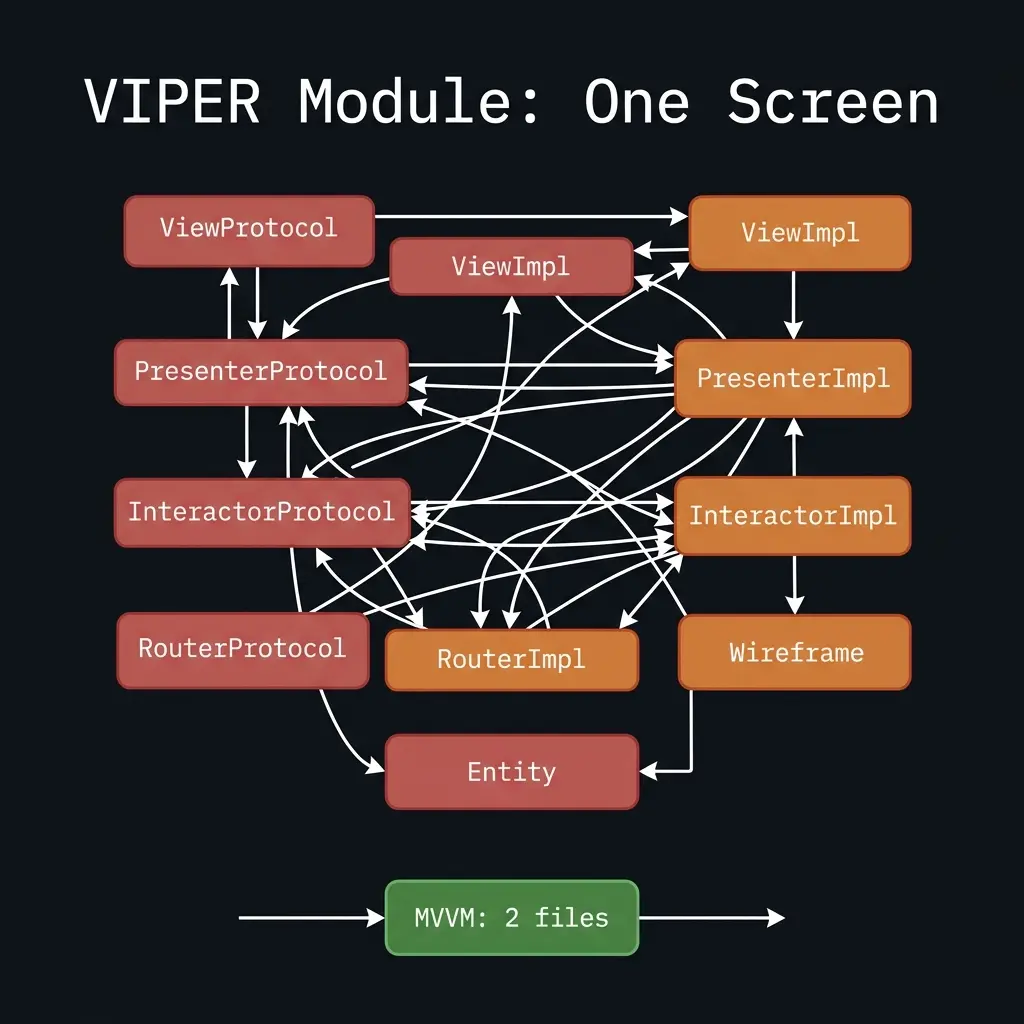
One screen in VIPER produces:
- A view protocol
- A view implementation
- A presenter protocol
- A presenter implementation
- An interactor protocol
- An interactor implementation
- A router protocol
- A router implementation
- An assembly or wireframe to wire them together
- Entity structs, usually more than one
Ten files for a single screen. A twenty screen app generates two hundred files before any feature ships. The file count is a distraction. The real cost is that every change touches all of them.
A Reddit user named n0damage put it plainly in 2017, in a comment that became one of the most cited criticisms of VIPER in the iOS community:
"VIPER is what happens when former enterprise Java programmers invade the iOS world. It imposes so much abstraction and structure that maintainability of code is reduced, not improved."
n0damage, r/iOSProgramming
The comparison to enterprise Java is specific. Java's Spring Framework famously produced classes like AbstractSingletonProxyFactoryBean. VIPER produces the iOS equivalent: eleven protocols and classes to read a date from a UIDatePicker and display it in a UITextField.
Add a field to the entity. The interactor passes it up. The presenter protocol needs a new parameter. The view protocol needs to accept it. Every layer absorbs a change that belongs to one layer. The protocol chain connecting them does not track whose responsibility the change was.
// You add a `subtitle` field to a model.
// This is what follows.

protocol ItemListInteractorOutput: AnyObject {
    func didFetch(items: [ItemEntity])  // was this
    func didFetch(items: [ItemEntity], subtitle: String)  // now this
}

protocol ItemListPresenterOutput: AnyObject {
    func update(viewModels: [ItemViewModel])  // was this
    func update(viewModels: [ItemViewModel], subtitle: String)  // now this
}

protocol ItemListViewInput: AnyObject {
    func show(viewModels: [ItemViewModel])  // was this
    func show(viewModels: [ItemViewModel], subtitle: String)  // now this
}
One field. Six files touched. Nothing shipped.
The protocol tax
VIPER runs on protocols. The Interactor holds a reference to a protocol, not the Presenter. The View holds a reference to a protocol, not the Presenter. No class in the system knows what anything else is concretely.
The stated reason is testability. Protocols let you inject mocks. You test the Interactor without the real Presenter, the Presenter without the real View. Clean seams.
In practice, every protocol has exactly one production implementation and one mock. The mock exists so the unit test can verify a method was called. That is the full extent of what the test checks. Whether the method did anything correct is outside its scope.
// A common VIPER unit test.
// What you're actually testing: the method was called.
// What you're not testing: whether the logic is right.

func testInteractorCallsPresenterOnSuccess() {
    let mockPresenter = MockItemListInteractorOutput()
    interactor.output = mockPresenter

    interactor.fetchItems()

    XCTAssertTrue(mockPresenter.didFetchCalled)
}
The test passes. The presenter could format data wrong. It could return items in the wrong order, skip an edge case, mangle a date. The test will never catch it. It confirmed a method was invoked and stopped there.
VIPER makes tests easy to write. Coverage numbers look healthy. The tests prove almost nothing, and the architecture makes that absence feel like thoroughness.
Reading a VIPER codebase
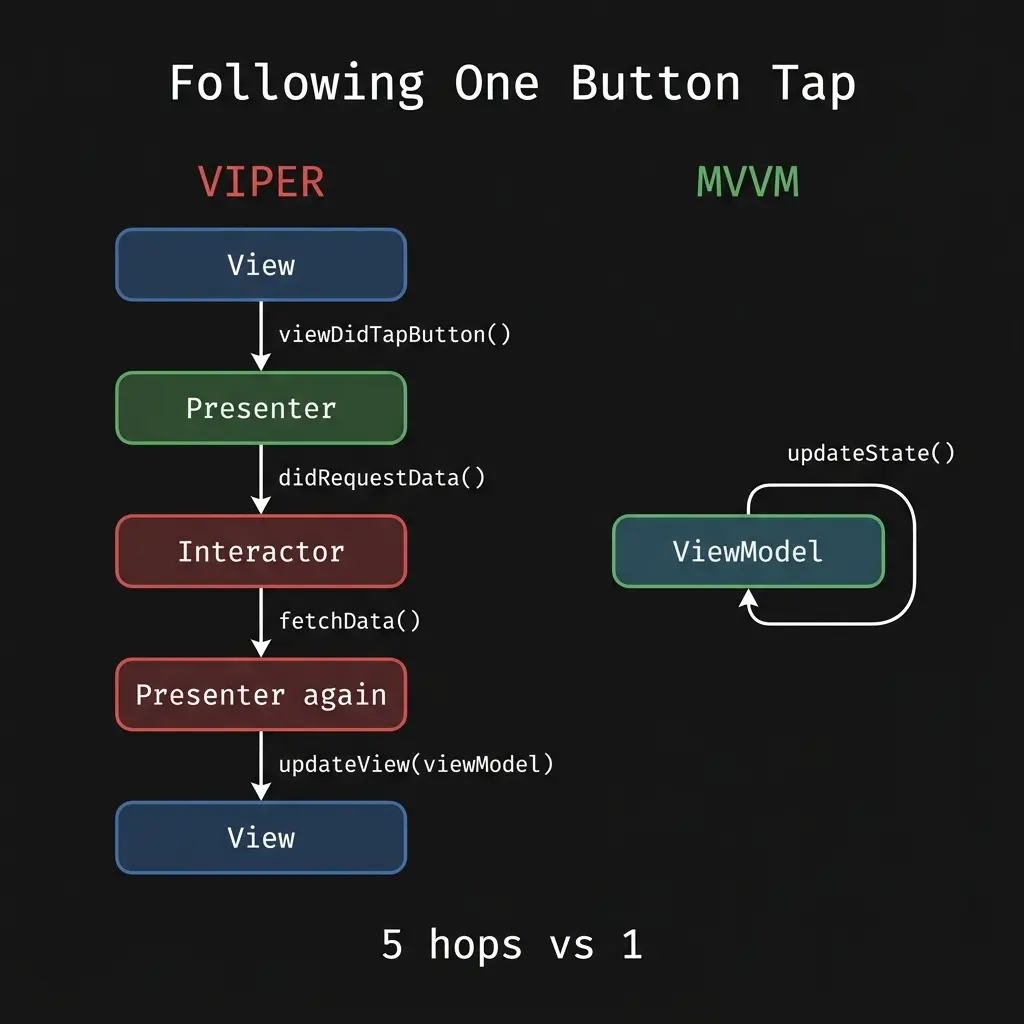
Open a VIPER codebase you did not write. Follow one button tap. The button calls output?.didTapConfirm(). Go to the presenter. The presenter calls interactor.confirm(with: item). Go to the interactor. The interactor calls a service, gets a result, fires output?.didConfirm(result: result). That output is the presenter again. The presenter formats the result, calls view?.show(formattedResult: result). Back where you started.
Five files. One action. The flow exists, traced through method calls across four classes. You wanted to understand the feature. You got a tour of the plumbing.
I once spent forty minutes tracing a bug where a list screen showed stale data after a pull to refresh. The Interactor was fetching correctly. The Presenter was formatting correctly. The problem was that the View's protocol method was being called, but the UITableView was not reloading because the callback arrived on a background thread and the Presenter did not dispatch to main. Forty minutes, four files, one missing DispatchQueue.main.async. In MVVM, the state change and the UI update would have been in the same function, and the bug would have been obvious in thirty seconds.
In a clean MVVM screen, that same tap is fifteen lines in a ViewModel function. The fetch, the state change, the formatting sit in one place. You read it once.
VIPER calls the five file version separation of concerns. That word does a lot of work.
The wireframe problem
VIPER navigation lives in the Router. Most teams rename it the Wireframe. The Wireframe instantiates view controllers, wires each module, and pushes or presents the next screen. Navigation logic moves out of the ViewController.
Cleaner in theory than in practice.
The Wireframe becomes a dependency injection site fused with a navigation coordinator. It instantiates the View, the Presenter, the Interactor, the next Wireframe, and holds a reference to the current ViewController so it can push from it. A user taps a button. The call goes through the Presenter into the Wireframe, which calls navigationController?.pushViewController(...) three layers from where the finger landed.
When navigation breaks, the stack trace runs through the Router, into the Wireframe, through the Presenter, back into the Wireframe. Debugging is excavation.
Every Wireframe has to know about the next module's Wireframe. Those Wireframes know about others. The dependency graph between routers in a large VIPER app is a second architectural problem hiding inside the first.
// ItemListWireframe needs to know about ItemDetailWireframe
// ItemDetailWireframe might need to know about CheckoutWireframe
// The coupling is horizontal, not vertical.
// There's no containment.

class ItemListWireframe: ItemListWireframeProtocol {
    func navigateToDetail(item: ItemEntity) {
        let detail = ItemDetailWireframe.createModule(item: item)
        viewController?.navigationController?.pushViewController(detail, animated: true)
    }
}
Navigation logic fused with module assembly, split across classes that each own part of the process and understand none of it whole.
Assembly and dependency injection
Every VIPER module is assembled by hand. The View takes the Presenter. The Presenter takes the View and the Interactor. The Interactor takes its output. The Wireframe holds references to everything and builds the graph.
Teams write a static factory, usually on the Wireframe:
static func createModule() -> UIViewController {
    let view = ItemListViewController()
    let presenter = ItemListPresenter()
    let interactor = ItemListInteractor()
    let wireframe = ItemListWireframe()

    view.output = presenter
    presenter.view = view
    presenter.interactor = interactor
    presenter.router = wireframe
    interactor.output = presenter
    wireframe.viewController = view

    return view
}
Every line is a place for a mistake that produces no immediate signal. Wire one property wrong and nothing crashes at the call site. The crash comes later, when a user taps something and the presenter's output is nil. A force unwrap takes the app down. A weak reference deallocates and the callback vanishes.
Explicit. Fragile. Written from scratch for every screen.
The single responsibility principle, misapplied
VIPER sells itself as the Single Responsibility Principle made architectural. One class, one job.
The SRP says a class should have one reason to change. A class that formats user objects for display changes when the display format changes. That is the entire principle.
VIPER converts this into a filing system. Business logic goes in the Interactor. Presentation goes in the Presenter. Navigation goes in the Router. The filing system is enforced whether or not the separation earns its cost on any given screen.
A screen with one or two pieces of data still produces five classes: the Interactor fetches an item, the Presenter formats it, the View displays it. Five files and five protocols for work that does not require five opinions.
The SRP is about tracking reasons to change. VIPER uses it as an org chart. One of these approaches produces maintainable code. The other produces files.
What good architecture does
Good architecture keeps things that change together near each other. Things that change on different schedules stay apart.
A login screen's layout, validation logic, and error state change together when the design changes. Keep them close. The credential validation service changes on a different schedule, driven by backend decisions. Keep that separate.
VIPER enforces structural separation without consulting actual change patterns. It splits presentation from interaction because the acronym says they are different, not because they change at different rates. Convention overrides what the codebase actually does.
This is where VIPER fails under product pressure. Designs change. Fields get added. Backend contracts shift. Every change cuts across layers because the boundaries were drawn by naming, not by the work. The seams land in the wrong places.
The ceremony
Add a loading state to a list screen. Touch the entity or the presenter model. Add a method to a protocol. Update the mock. Implement it in the concrete class. Wire the view update through the protocol chain. Write a test confirming the presenter told the view to show loading.
Seven steps for a loading spinner. None of them about the product.
I remember a ticket that should have taken an hour: add a "last updated" timestamp below a list. The entity needed a new field. The Interactor needed to pass it through. The Presenter protocol needed a new method parameter. The mock needed updating. The View protocol needed a new method. The concrete View needed to display it. The test needed to verify the Presenter called the View with the timestamp. Seven files touched. The actual formatting logic was one line: DateFormatter with a medium style. The rest was wiring.
Raymond Law, creator of the Clean Swift framework and himself a critic of VIPER's structure, identified the core problem:
"VIPER puts the presenter at the center of the universe. Because of this, the presenter has references to every other component in the scene. As a result, you'll end up with a massive presenter."
Raymond Law, clean-swift.com
The Massive ViewController problem does not disappear. It moves to the Presenter. The ceremony around it grows.
The ceremony hides in the architecture diagrams. Blog posts never draw it. Developers live in it, one ticket at a time, every protocol update, every mock revision. The tax is constant and does not shrink for small features.
After six months, teams bend the rules. Protocol boundaries relax. Presenters reach into things they should not. Interactors absorb service logic. The architecture degrades. What remains is the overhead without the discipline. VIPER without the separation is a complicated file structure and nothing else.
Why teams adopt it anyway
The social dimension of VIPER adoption is real.
Teams that chose VIPER had seen Massive ViewController codebases with twenty thousand lines in a single file. Untestable. Unreadable. They knew something had to force a change, and VIPER offered structure, a shared vocabulary, and buy in from engineers who had thought about the problem.
The alternative in 2015 was discipline applied to MVC. That approach works, but it is hard to enforce across a team, hard to explain in interviews, and impossible to point to in a code review. VIPER had names for things. The legibility had real value even when the system underneath was overbuilt.
Aleksandar Vacić, an iOS developer who watched these cycles from the beginning, wrote in 2017:
"I can't shake the feeling these same kind of Javascript architects descended into iOS in full force and with them brought the habits of creating new amazing, best, evar library every few months."
Aleksandar Vacić, aplus.rs
The pattern arrived at a moment when the community was desperate for structure. That desperation made it harder to ask whether the structure was the right one.
There was also a credibility signal. VIPER appeared in job descriptions. Teams that used it could claim clean architecture, which is harder to assert about well organized MVC even if the code quality is identical. The pattern became a proxy for seriousness. The proxy was not evidence of better software.
What happened next
The iOS community kept searching. RxSwift, MVVM with Combine, the Composable Architecture, SwiftUI. Each was a response to something real, the same way VIPER was.
The difference is fit. MVVM sits closer to how product work happens because the ViewModel and the View change together. When the screen changes, the ViewModel changes. That proximity reflects how requirements actually move. VIPER's five layer split fights that cohesion at every step.
SwiftUI makes the point sharper. State lives in the object that owns it. Views read state and rerender. The model is separate. Navigation sits wherever it makes sense. The structure adapts to the problem.
VIPER does not adapt. It applies five layers to a login screen and an order management dashboard the same way, with the same cost, regardless of complexity, team size, or how often the requirements move.
Why SwiftUI kills VIPER
VIPER was designed for UIKit. Every assumption it makes about how views, presenters, and routers interact is rooted in reference types, imperative updates, and UIViewController lifecycle management. SwiftUI violates all of them.
Views are structs, not classes. In UIKit, a Presenter holds a weak reference to the ViewController and calls methods on it: view.show(data). That is the core of the Presenter to View contract. In SwiftUI, the View is a struct. It is a value type. The framework creates and destroys it constantly. You cannot hold a reference to it. The entire ViewInput protocol pattern, the mechanism VIPER uses to push updates from the Presenter to the View, does not compile.
To make it work, teams turn the Presenter into an ObservableObject and have the View subscribe to it with @StateObject. At that point the Presenter is a ViewModel. You have MVVM with extra files.
State flows in the wrong direction. VIPER uses a push model. The Interactor fetches data, hands it to the Presenter, the Presenter formats it, then pushes it to the View. SwiftUI uses a pull model. The View declares what state it depends on and rerenders when that state changes. The View does not receive commands. It reacts to mutations in state objects.
Forcing a push model onto a pull framework produces bridging code that exists to translate between two state paradigms inside the same screen. The bridging is overhead that buys nothing. The View could observe the state directly.
The Router has no surface to attach to. VIPER navigation relies on the Router holding a reference to the current UIViewController and calling pushViewController, present, or dismiss on it. SwiftUI navigation is state driven. NavigationStack and NavigationPath, introduced in iOS 16, manage the navigation hierarchy through value mutations. There is no view controller to push from. There is no navigation controller to reference.
Teams that try to keep a VIPER Router in SwiftUI end up wrapping NavigationPath in a coordinator object, then wrapping that coordinator in a Router, then passing the Router into the Presenter. The result is three layers of indirection around a feature that SwiftUI provides in one line of state declaration.
Hybrid codebases pay double. Large apps migrating from UIKit to SwiftUI face a practical problem: the existing VIPER modules use UIViewController and protocol delegates. The new SwiftUI screens use @Observable and state binding. Connecting them requires adapter objects, UIViewControllerRepresentable bridges, and careful lifecycle management to avoid retain cycles between the two paradigms. Teams end up maintaining two architectural styles in the same codebase, each with its own wiring patterns, its own testing approach, and its own set of bugs.
The migration path from VIPER to SwiftUI is not incremental. It is a rewrite with an adapter layer that grows more expensive the longer both systems coexist.
The files are not the architecture
VIPER teams generate files and call it structure. The count is visible. It shows up in pull requests, in onboarding docs, in code review. The architecture reads cleanly in the Finder window.
Architecture is the shape of dependencies: where change propagates, where new requirements land cleanly, where they shatter. A codebase with three hundred well named files can have the same dependency tangle as one with thirty large ones. The file count is surface.
VIPER creates the appearance of order through naming and directory layout. This has communication value. Teams can refer to the Interactor and agree on what they mean. But communicating about a structure and managing complexity through that structure are separate things. Confusing the first for the second is how teams stop asking whether the pattern is earning its keep.
When it might be worth it
Large teams where strict layer enforcement keeps one developer's changes from colliding with another's can absorb the overhead. Regulated domains where explicit separation between business logic and UI is a compliance requirement have a reason for the ceremony. Legacy Objective-C codebases where Massive ViewController was too entrenched for lighter intervention sometimes needed VIPER's forcing function.
These cases exist but are not common. They are not the situation most teams are in when they adopt VIPER because it appeared in a conference talk or because the senior engineer used it at a previous company.
Most iOS apps have one or two developers. The screens in those apps are rarely complex enough for five layers of abstraction to reduce cognitive load. An architecture that requires ten files and eight protocols to add a subtitle field is overhead carried from day one, not a foundation that earns its weight later.
What to use instead
The answer depends on what you are building.
A small team on a straightforward app can go far with SwiftUI's built in state management. @Observable ViewModels, clean service interfaces, consistent navigation patterns. Less scaffolding, more working code.
To make the difference concrete: that same item list screen that produced ten files in VIPER looks like this in SwiftUI with @Observable:
@Observable
class ItemListViewModel {
    var items: [Item] = []
    var isLoading = false
    var error: Error?

    private let service: ItemService

    init(service: ItemService) {
        self.service = service
    }

    func fetchItems() async {
        isLoading = true
        do {
            items = try await service.getItems()
        } catch {
            self.error = error
        }
        isLoading = false
    }
}

struct ItemListView: View {
    @State var viewModel: ItemListViewModel

    var body: some View {
        List(viewModel.items) { item in
            Text(item.title)
        }
        .overlay {
            if viewModel.isLoading {
                ProgressView()
            }
        }
        .task { await viewModel.fetchItems() }
    }
}
Two files. One class, one struct. The fetch, the state, the error handling, the loading indicator, all in one place. Adding a subtitle field means adding one property to the model and one Text line to the view. No protocols. No mocks. No ceremony. The @Observable macro handles the view invalidation. SwiftUI handles the rerender.
A team with genuinely complex state should look at TCA or carefully structured MVVM with dependency injection. The overhead is real, but it corresponds to something real: state that is difficult to reason about and dependencies that need to be testable. The weight is earned.
A large team with strict testing requirements and complex domain logic may find TCA's reducer model worth the cost. The boilerplate maps to actual complexity rather than performing structure where none is needed.
VIPER's overhead maps to nothing except the pattern itself. You pay the five layer tax whether the screen needs five layers or not. You write protocols whether you have more than one implementation or not. The architecture justifies itself by existing, which is the definition of bureaucracy.
What VIPER taught us
VIPER was right about the problem. Massive ViewController was real and the iOS community needed a harder answer than "be more disciplined."
The prescription was wrong. VIPER took a correct observation about tangled responsibilities and answered with a rigid taxonomy applied identically to every screen. A login form and an order management interface got the same five layers, the same protocol chains, the same assembly cost. The pattern treated all complexity as equivalent, which means it addressed none of it specifically.
Good architecture is judgment applied to structure. It means knowing which things change together and keeping them close, knowing which boundaries need to be explicit, and paying only for those. VIPER replaced judgment with a rulebook. The rulebook gave teams a shared language, and shared language has genuine value. But a shared language is not the same as understanding why the vocabulary exists.
The developers who got value from VIPER understood why each layer existed and could recognize when a boundary was earning its cost. They could have built something better without the pattern. VIPER gave them a starting point, and they reasoned past it.
Most teams adopted the whole structure without the reasoning. That is where the cost accumulates. Not in the files or the protocols, but in the years spent maintaining a structure nobody questions because the questioning was never part of the adoption.
The observations VIPER encoded are correct: presentation logic and business logic have different reasons to change, and navigation does not belong in the view controller. These ideas predate VIPER and will outlast it. The mistake is treating them as justification for the full apparatus. The insight is worth keeping. The apparatus is not.
I still carry what VIPER taught me about separating presentation from business logic. I just no longer carry the ten files it demanded as payment.