Every few months, the same thread surfaces somewhere. "Is React dead?" "Why are people still using Python?" "Rust will replace everything." It runs on the same cycle as sports rivalries, with the same ratio of heat to light: very high and very low, respectively.
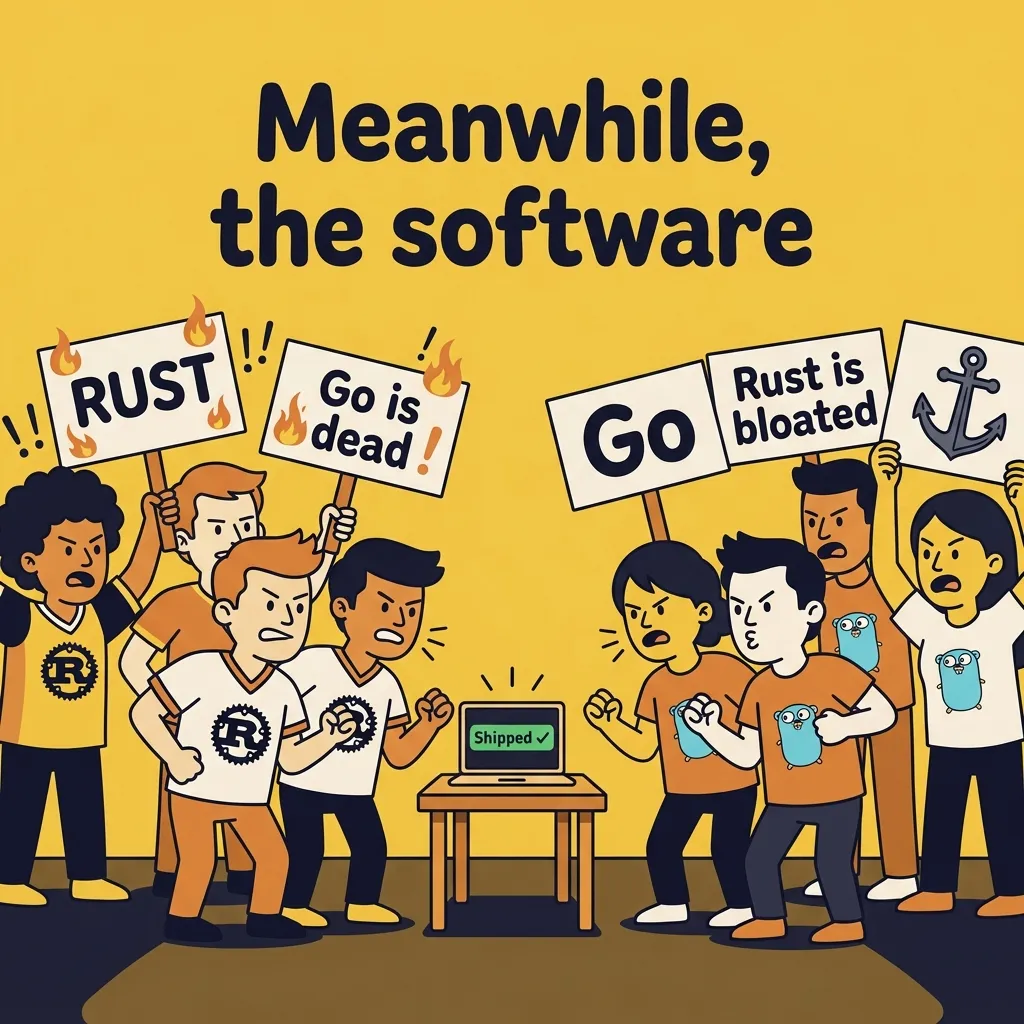
I've been a software engineer long enough to have moved through several of these cycles. I watched the JavaScript framework wars. I watched the NoSQL vs relational database debate consume conference talks for years. I watched Go and Rust advocates declare each other's language philosophically bankrupt. The loudest voices in these conversations are rarely the ones shipping the most meaningful software.
The debate itself is the signal
When you see a developer deeply invested in proving that one tool is objectively superior to another, you're not watching someone reason about software. You're watching someone defend their identity.
A programming language is a syntax and a runtime. A framework is a set of conventions wrapped around a problem. A library is code someone else wrote. None of them are belief systems. None of them require defending. If your tool is good for the problem at hand, you don't need to convert anyone. The software ships, the users win, and the conversation ends.
The debate usually starts when someone's choice of tool has become part of how they see themselves professionally. "I'm a React developer." "I'm a Rustacean." "I do things the functional way." Once the tool becomes the identity, any criticism of the tool feels like a personal attack and the reply has to be proportionally defensive.
This also explains why the debates feel so circular. No amount of benchmark data or case study evidence lands because the argument was never really about which tool is technically better. It was about who gets to feel like they made the right call.
What the benchmarks are actually measuring
Most "language X is faster than language Y" benchmarks measure how fast a contrived operation runs on someone's machine with a particular compiler flag and a particular input size. They rarely measure anything you'd encounter in a real codebase.
Take the Rust vs Go argument. Rust advocates point to zero cost abstractions and memory safety without a garbage collector. Go advocates point to compile times, simplicity, and the standard library. Both arguments are correct. Rust is better for systems programming where you need fine grained control over memory and can't afford a GC pause. Go is better for networked services where you want fast iteration, readable code, and a runtime that handles concurrency without ceremony.
There is no winner because they were built for different things. Choosing between them on a real project usually takes about ten minutes of thinking about your team's background, your latency requirements, and what you'll be maintaining in five years. The online argument takes thousands of hours across millions of threads.
MongoDB versus PostgreSQL is not a philosophical debate. It's a question about whether your data has a fixed schema and whether you need transactions. React versus Angular is not a war between good and evil. It's a question about team size, project duration, and how much structure you want baked in. Python versus Go for backend services depends entirely on whether you're writing data pipelines or high throughput APIs.
All of these have answers when you describe the actual problem. The debate only persists when you remove the problem from the equation.
Resume driven development is real and it's expensive
Some of this isn't tribalism. It's career incentives. Technologies that dominate job listings pull developers toward them regardless of fit. Developers want to stay marketable, so they build with what they see on LinkedIn, not what the project needs.
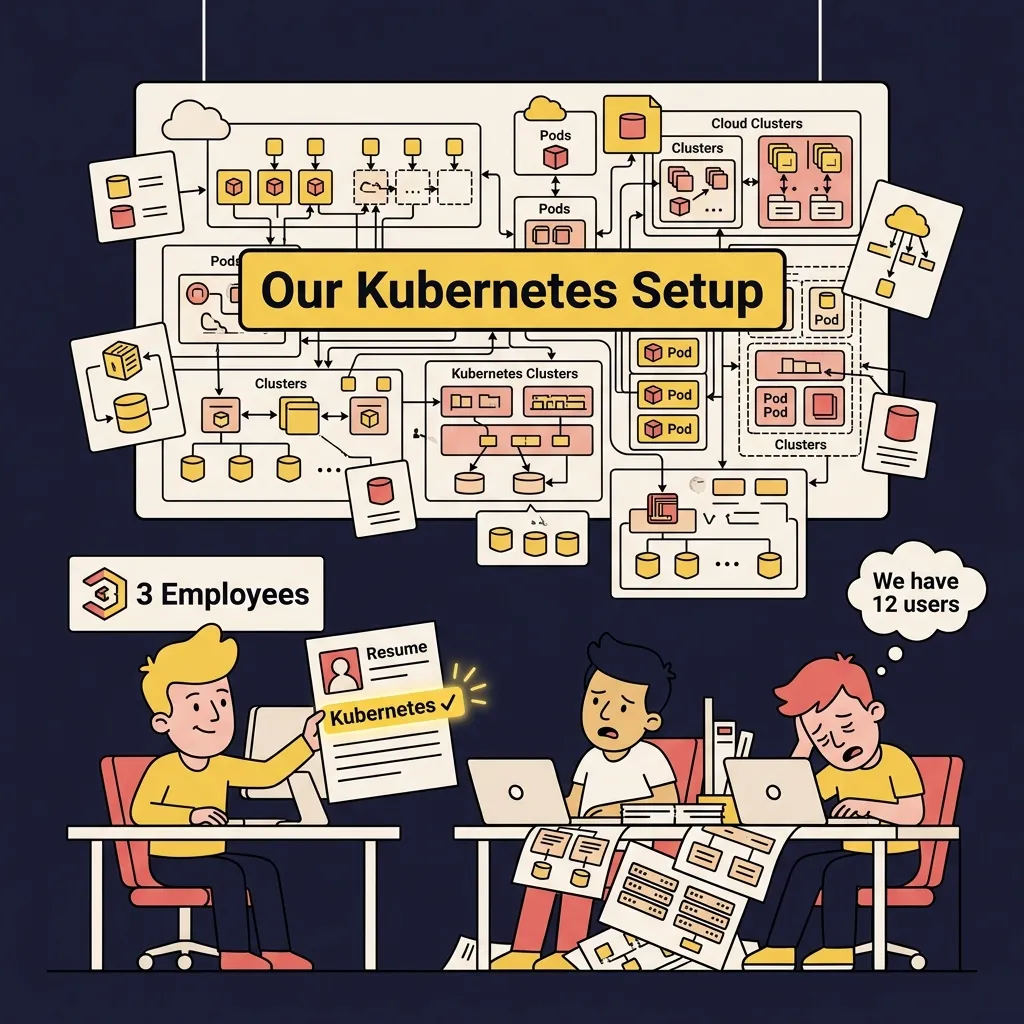
This produces a predictable outcome: developers choose a technology because they want it on their resume, then retrofit the architecture around that choice. I've seen teams introduce Kubernetes into a three person startup because the lead engineer wanted the experience. I've seen companies migrate to microservices before they understood their own domain boundaries, purely because distributed systems were trending. The migration cost was real. The architectural benefit was not.
The inverse also happens. Technologies that aren't trending get avoided even when they're the right tool. A carefully maintained SQL database with proper indexes and a few stored procedures can handle load that takes most startups years to reach. But it doesn't generate conference talks or pull requests on GitHub, so it reads as less impressive than whatever distributed system is getting written up on Hacker News.
The technology in these decisions is mostly irrelevant to the actual goal, which is building something that works, can be maintained, and solves the user's problem efficiently. The technology is a means to that end. When it becomes the end, things go wrong.
What actually transfers
Good engineers pick up new technologies fast. Not because they're generically talented, but because they understood the concepts underneath their current tools deeply enough that the new tool is mostly just different syntax for familiar ideas.
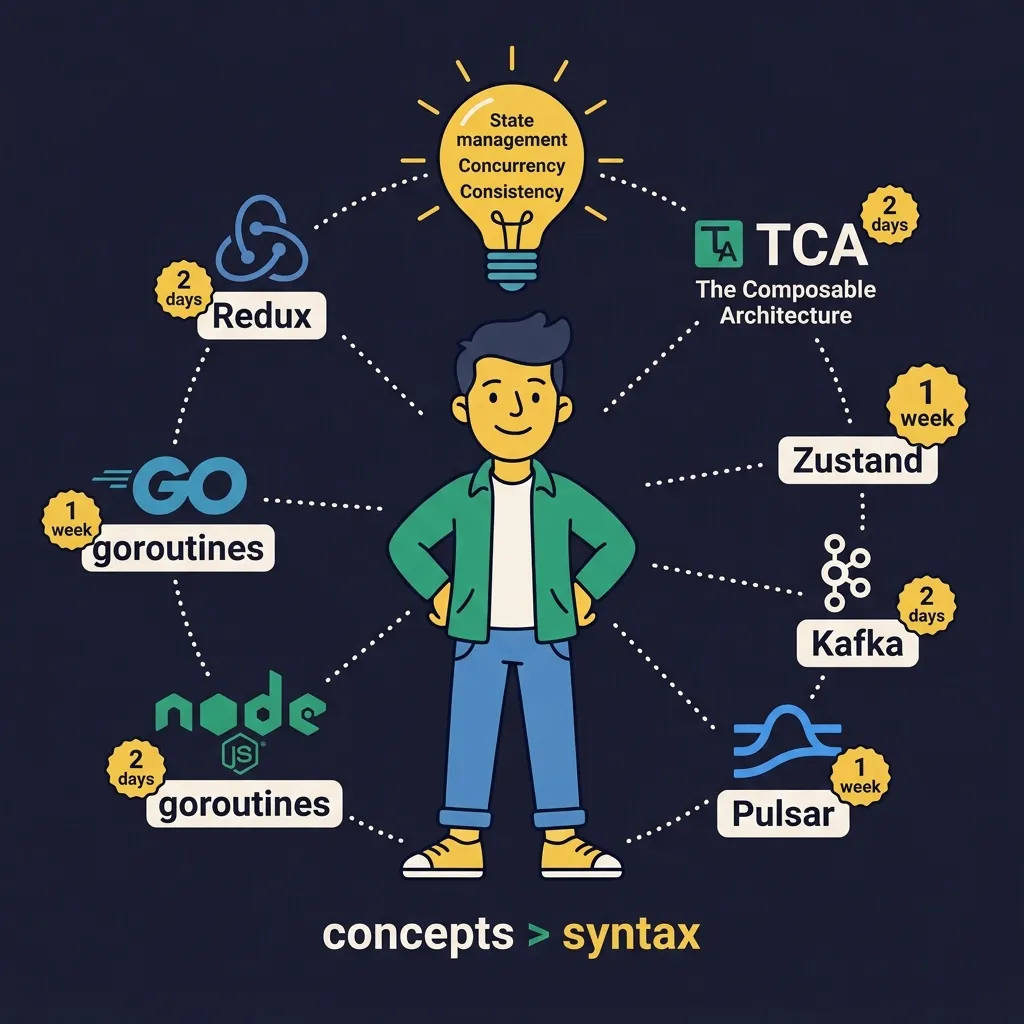
The engineer who really understood how event loops work in Node.js picked up Go's goroutines in a week. The engineer who understood why Redux works the way it does understood TCA before reading the docs. The engineer who could explain exactly what a database index does could debug a slow Firestore query on their first day using Firestore.
What transfers is the understanding of the underlying problem: concurrency, state, persistence, network latency, memory, consistency. The frameworks change. The problems they address are largely stable.
This is what "know your tools" actually means. Not "have opinions about which tools are best." Know what problem each tool is solving, what trade offs it made to solve it, and what class of problem it handles poorly. With that mental model, you can make good decisions quickly without needing to have tried every option in production.
The "it depends" answer isn't a cop out
Junior developers often interpret "it depends" as a deflection. It isn't. It's the correct answer to almost every question that starts with "which is better."
The question "which is better, REST or GraphQL?" has a real answer: it depends on whether your clients have highly variable data needs and whether your team can absorb the overhead of a GraphQL server and query complexity management. For a simple CRUD API with a handful of endpoints, REST is probably better. For a client with many different consumers each needing very different data shapes, GraphQL probably earns its cost.
If someone asks whether SQL is better than NoSQL, the answer depends entirely on whether your data has a consistent structure, whether you need ACID transactions, and how frequently your schema changes. Neither is better. They were designed for different data models.
Even the question "which programming language is best?" has an answer, provided you set the constraints. Best for what workload? Best for what team? Best for what maintenance timeline? With context, the question becomes answerable. Without context, it's just taste dressed as analysis.
The best engineers I know are suspicious of tools they've never seen fail. They ask "what breaks?" before "what can it do?" and they're comfortable holding an opinion about trade offs without holding an allegiance to any particular technology.
The tools will keep changing
Every technology that dominates the conversation today replaced something that dominated five years ago. React replaced Backbone and Angular 1. Kubernetes became the answer to problems that Heroku used to solve more simply. SwiftUI is gradually eating UIKit. Rust is doing to C++ what C++ did to C in userland applications.
If your professional value is tied to a specific tool, this is unsettling. The tool you built your career around will eventually be the tool a new generation argues against.
If your professional value is tied to understanding the problems that tools address, this is just background noise. The distributed systems knowledge you built on Kafka transfers to Pulsar. The state management intuitions you built on Redux transfer to TCA, Zustand, or whatever comes next. The database trade off reasoning you developed carries forward regardless of which database is current.
The developers I find most valuable are the ones who can walk into a new stack and contribute meaningfully within a week because they understand computation, not frameworks. They're not posting about which runtime is philosophically superior. They're reading the docs, running the code, and figuring out what breaks under load. The debates are a distraction from that.
Where this leaves you
None of this means tools don't matter. Choosing the wrong one has real costs: slow performance, mounting maintenance debt, team friction, a hiring pool that's already stretched thin. These are genuine engineering concerns.
But there is a real gap between "this tool is a poor fit for this specific problem" and "this tool is objectively inferior and anyone who uses it is wrong." The first is an engineering decision. The second is a tribal claim.
Most online debate sits in the second category while sounding like the first. The tells are easy to spot: the problem being solved is never named, conditions where the other tool wins are never acknowledged, and the tone escalates the moment anyone pushes back.
Good software engineering is mostly in the boring middle. You understand the problem, pick tools that fit it, and build something that works. The tools are not the interesting part.
Once that clicks, you stop watching the debates. Not because you've stopped caring about technology, but because the people actually solving the hardest problems are mostly too busy to argue about what hammer they're using.